my wonderful other half got this great idea of me doing a podcast, and because that sounds both exciting and scary at the same time… I’m going to do it! hmmmm now…. what am I going to need… time to get to work!
Page 27 of 28
Varieties of Quartz:
Abakusz-kö
Agate
Agate-Jasper
Amarillo Stone
Amberine
Amethyst
Ametrine
Apricotine
Arkansas Candle
Aventurine
Azurchalcedony
Babel-Quartz
Ball Jasper
Basanite
Bayate
Beekite
Binghamite
Bloodstone
Blue Lace Agate
Blue Quartz
Botswana Agate
Brecciated Agate
Buhrstone
Bull Quartz
Cape May Diamonds
Capped Quartz
Carnelian
Chalcedony
Chert
Chrome-Chalcedony
Chrysojasper
Citrine Clear
Lake Diamonds
Cloud Agate
Cotterite
Crazy Lace Agate
Creolite
Cubic Quartz
Cubosilicite
Dallasite
Damsonite
Darlingite
Dendritic Agate
Diackethyst
Egyptian Jasper
Eisenkiesel
El Doradoite
Enhydro Agate
Eye Agate
Fairburn Agate
Ferruginous Quartz
Fire Agate
Flint
Fortification Agate
Fossil Agate
Gwindle Quartz
Haema-ovoid-agates
Hair Amethyst
Haytorite
Hedgehog Stone
Herbeckite
Herkimer Diamond
Herradura Diamonds
Iris Agate
Jacinto de Compostela Quartz
Jasper
Keystonite Chalcedony
Laguna Agate
Lake County Diamonds
Lake Superior Agate
Landscape Agate
Lithium Quartz
Mexican Lace Agate
Milky Quartz
Mocha Stone
Moss Agate
Myrickite
Nipomo Agate
Oil Quartz
Onyx
Orbicular Jasper
Owyhee Jasper
Pastelite
Petrified Wood
Pigeon Blood Agate
Plasma
Plume Agate
Prase
Prase-malachite Quartzine
Quetzalitztli
Riband Agate
Riband Jasper
Ribbonstone
Rock Crystal
Rose Quartz
Rutilated Quartz
Sagenite (of Kunz)
Sard
Sardonyx
Sceptre Quartz
Seftonite
Smoky Quartz
Star Quartz
Taconite
Vallum Diamond
Vogelaugenachat
Vogelaugenjaspis
Wilkite Youngite
Agate:
variety of Chalcedony which is in turn a variety of Quartz….
A distinctly banded variety of chalcedony
type locals: Dirillo River, Acate, Ragusa Province, Sicily Italy
Name: derived from Achates River in south Sicily
Varieties:
Abakusz-kö Agate-Jasper Blue Lace Agate
Botswana Agate Brecciated Agate Cloud Agate
Crazy Lace Agate Enhydro Agate Eye Agate
Fairburn Agate Fire Agate Fortification Agate
Fossil Agate Haema-ovoid-agates Herbeckite
Iris Agate Laguna Agate Lake Superior Agate
Mexican Lace Agate Mocha Stone Nipomo Agate
Onyx Pigeon Blood Agate Plume Agate
Riband Agate Sardonyx Vogelaugenachat
Youngite
Chalcedony: “Traditionally defined as a fibrous cryptocrystalline variety of quartz, more recently it has been shown that chalcedony is a mixture of quarts and moganite*, another silica mineral”
*I guess this one gets a post too!
Crystal system: Trigonal
Notes: concentrically banded its agate, layers/bands also called onyx, non banded forms (moss agate) and also its what replaces wood in petrified wood.
Varieties*:
Agate*
Amarillo Stone Amberine Azurchalcedony
Beekite Binghamite Bloodstone
Buhrstone
Carnelian Chrome-Chalcedony
Cubosilicite Damsonite
Dendritic Agate**
Diackethyst Keystonite Chalcedony Landscape Agate**
Moss Agate** Myrickite Orbicular Jasper
Petrified Wood
Plasma Quartzine
Sard Seftonite
*Agate varieties are listed above
** not true agates

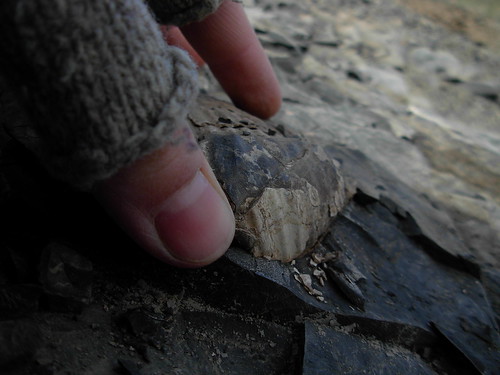
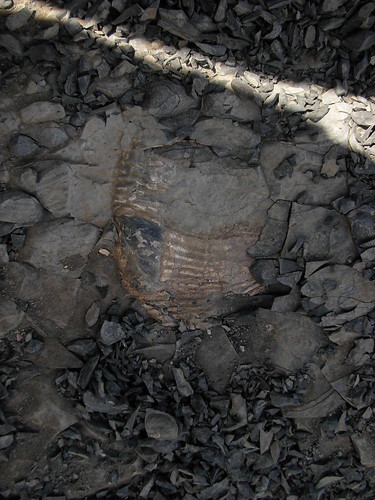
Yes I went somewhere beautiful last weekend! I drove up the Glenn Hwy to hunt for fossils in a friends field area. He has a dinosaur he is studying and we went to help find fossils to constrain the age of the deposit. So, long story short the really awesome ones now belong to our museum but will forever have my initials attached to them!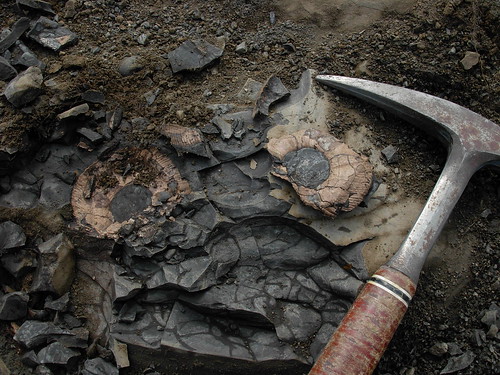
Quartz
Empirical Formula: (SiO2)
Synonyms from webmineral:
- Agate – banded variety of chaledony
- Amethyst – purple
- Avanturine – feebly translucent chalcedony
- Carnelian – flesh red chalcedony
- Cat’s Eye – chatoyant
- Chalcedony – microcrystalline quartz
- Chert – cryptocrystalline quartz
- Chrysoprase – apple green chalcedony
- Citrine – yellow
- Flint – microcrystalline quartz
- Hornstone – flint
- Jasper – red or brown chalcedony
- Moss Agate – variety of chaledony
- Plasma – green chalcedony
- Prase – leek green chalcedony
- Rock Crystal
- Rose Quartz – rose colored
- Sapphire Quartz – blue colored
- Smoky Quartz – brown to black
- Tiger Eye – pseudomorph of asbestos
Check out that list! Its going to be a long post this one! First the general information and then I am going to pick it apart one at a time and for metaphysical stuff!
Cleavage: {0110} indistinct
Fracture: conchoidal fracture (characterized by smoothly curving surfaces)
luster: vitreous (glassy)
streak: white
Environment: sedimentary, metamorphic, AND igneous rocks!
crystal habit: crystalline (course and fine), druse (Crystal growth in a cavity which results in numerous crystal tipped surfaces)
color: brown, colorless, violet, gray, yellow, rose, green, orange….
crystal system: tiagonal
hardness: 7
optical properties: uniaxial

Quartz notes: Quartz is the most common mineral found on the surface of the Earth. A significant component of many igneous, metamorphic and sedimentary rocks, this natural form of silicon dioxide is found in an impressive range of varieties and colours. There are many names for different varieties.
Varieties*:
*what I really want to focus on here is what makes something “quartz” vs “chalcedony” vs “agate” for example, and I am going to make a separate post about varieties, there are just too many of them!
References:
Metaphysical:
Thinking about rocks
I am surrounded by them, all the time. I do use them a lot in my magical practice so I took the time to think about the ones on my alter and what I use them to represent. And turns out, mostly its where I found them and how they formed.
I have river cobles and beach stones that have been warn smooth by the water, and that’s what I associate them with, the power of water. I also have bits of coral and shells and a crab shell that I found on the beach (note: if it’s a shell that say a hermit crab could use for a home I usually leave them, I like weathered bits of shells more then whole ones)
Lava! I have a lot of different volcanoes, I have ash from Mt Redoubt, rocks from Hawaii (I have an opinion about that curse… and some inside information I’ll tell you if you ask me 😉 ) some from Mt St Helens area, and a few other places (obsidian from Nevada….) This I associate with fire, and power and magma! Again back to how it formed, most of them violently!
I have large calcite crystals that precipitated from water, cool other rocks, that formed in a variety of ways, meta-sediments, sediments, fossils, to me these are earth, the constant recycling of material on the surface, brings to mind the cycle of explosions of life and mass extinction, and the rock cycle.
I don’t have rocks that mean air to me right now, but if I got my hand on some wind carved sandstone or nice dune cross beds, those rocks would be air to me and the power of the wind.
I guess what I am trying to say is that I have always felt that the energies in stones come more from how they were formed, or eroded then what their chemical make up is. I’ll try and come up with some good GEO 101 info on different rock forming environments. I tend to think they are pretty damn cool, but then I am a geologist
Oh and I am going fossil hunting this weekend! EEEEE so exciting!
TTBOOK is talking about this video today (I love podcasts!) and this video makes me smile every time without fail!
“Stand by Me” performed by musicians around the world from SKAT on Vimeo.
Ok pictures later tonight but I thought I would start writing this up!
Olivine – engagement ring
Olivine – sand
basalt – lots from Hawaii
Redoubt Volcano Ash

my first stab at lapidary

calcite – GIANT cool rock from the mine my S.O. worked at last summer

coral – Hawaii
fossils – Jewelry

Garnet – pentacle ring I have had for 10 years
Moon Stone ( feldspar) – Necklace

various beach and river cobbles
 book end
thats all I can see from where I am sitting, I also have a rock collection box in the closet, under the bed, the really nice ones are in a nice box in the bedroom, and several on my desk at school…
Well, yeah, I still am speechless.
You guys (and by guys I mean fellow pagans) should also know that mother earth… not the caring let you do it the easy way kind of mother more like, does exactly what you are not expecting just to see that confused look on your face….
so this makes me very sad. Please be nice to seismologists, we live where there are EQs just like the rest of you and we do try, very hard, we just can’t do the impossible, we are only people.
Scientists May Face Manslaughter Charges After Earthquake
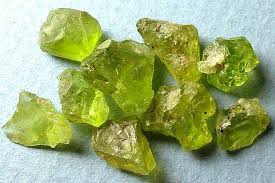
Why I am starting with Olivine: Olivine is one of the most abundant mineral in the mantle and its properties make my research possible! Plus its very pretty and that’s what my engagement ring is made of! So here we go!
Olivine:
From Wikipedia: magnesium iron silicate with the formula (Mg,Fe)2SiO4. It is one of the most common minerals on Earth, and has also been identified in meteorites, the Moon, Mars, in the dust of comet Wild 2, and within the core of comet Tempel 1.
Mineral data – most of this is what you use to identify the mineral so… the general public doesn’t really care about most of these but I’ll put them here anyways…

Composition Olivine Group: (Mg,Fe)2SiO4
Forsterite (Fo): Mg2SiO4
Fayalite (Fa): Fe2SiO4
Color: Green! Yellow to yellow green and olive green (Hence the name)
Crystal Habit: massive to granular
Crystal system: Orthorhombic
Cleavage: poor ( {001} good, {010} distinct )
Fracture: Conchoidal – brittle
Hardness: 6.5-7
Luster: vitreous (glassy)
Streak: white
Optical properties: biaxial
Composition notes:
– Most olivine exists between Fosterite and Fayalite, and the majority is fosterite rich.
– You can also get Manganese (Mn) substituted in and form tephrolite (Te) Mn2SiO4
Uses: a clear gem variety is called peridot. It is also used as a refractory sand to make molds for certain types of casting procedures in foundries and infrequently as an abrasive. It can also be used in CO2 sequestration
Why is it important:
– The mantle is dominantly olivine and thus the anisotropic nature of the olivine splits seismic waves and allows for studying the mantle flow patters which is my thesis. Cool huh?
– At higher pressures and temperatures olivine is not stable (it also isn’t stable at surface pressures and temperatures)
– At around 400km depth in the mantle olivine undergoes a change from an olivine structure to a spinel structure. This causes an increase in seismic velocity called the 410 discontinuity
– Olivine is more important to me because well I’m a seismologist and I study the deep mantle. Which I think is the most bad ass thing to study! But that’s just me
Names: Olivine, peridot, chrysolite, Fosterite, fayalite, tephrolite
Metaphysical
Energy: receptive
Planet: venus*
Elements: earth
Powers: Protection, health, wealth and sleep
“this stone is used to attract love as well as to calm raging anger. It is also used to sooth nervousness and to dispel all negative emotions. Because it is calming to the nervous system, it is also helpful in promoting a good nights sleep if warn to bed. Use in wealth-attracting spells to increase the odds of attracting more money or assets.”
* now I want to know what Venus is composted of…Basalt is the answer! There is olive then
Peridot associations: Scorpio, Healing and protective. Allows one to understand changes in one’s life, regulates life cycles,
Peridot olivine is the birthstone for August
“Found in meteorites. Completely aligns all the subtle bodies. This helps one receive information from the higher self more easily. Good stone for channeling. Visionary stone – it helps connect us to our destinies and to an understanding of the purpose of existence. Keeps the mind free from envious thoughts and jealousies. A good stone for people who cannot relate to realities beyond the physical world. Aids in manifesting physical work into material abundance. A healing stone working with the heart and solar plexus chakras.
Balances glandular system. Aids tissue regeneration. Has beneficial influence on heart, pancreas, spleen, liver, adrenals. Purifies body. Enhances bloodstream. Overal balancer and tonic for body/mind. Aligns subtle bodies. Increase intuitative awareness. Reduces stress. Stimulates mind. Accelerates personal growth. Opens new doors or opportunity.”
Chrysolite: A golden yellow variety of peridot. It supposedly can help prevent fever and madness.
Photos:
Gem quality (the pretty ones):
.jpg)

Hand sample:

Thin section:
.jpg)

In rocks:


Discussion:
To me olivine represents something primitive and deep. The mantle is olivine and the oceans crust is basalt which usually has a fair deep of olivine in it. Basaltic volcanoes like Hawaii’s Kailua also come to mind as well as the deep rich green. If you were looking for a mineral to sum up the whole earth well… this would be one of them! In my mind.
I am going to start studying mineralogy again, on my own… I think the reason I have been putting it off for so long is how traumatized I was in that class! hehehe
So I am going to study my minerals and then add some gem names and some of the association that go with them! And pictures, I’ll try and get some hand sample as well as thin section pictures. I usually don’t use minerals much in my works but I am thinking I might start trying it out. I will most likely add my thoughts on associations based on my experiences with them. I am going to try and find a nice long list of all the different varieties and gem names for each of these minerals, some of these lists will be very long and I might go back and edit these so do not in any way consider any post “done” I’ll try and make a note on the bottom when I update them. I am adding a tag “mineralogy” to all of these blog posts so you can find them and what you are looking for quickly in my random babbles and craziness!
I might move on to some petrology eventually as well, or assemblages of minerals and what associations you might use for each of them, I haven’t seen much in the way of rocks, but in nature mostly you get minerals from a rock so its good to know where the minerals come from and what other minerals are usually associated with it. But thats just my opinion!
I am going to go through the minerals from my list in mineralogy undergrad and I am going to use the text Introduction to Mineralogy by William D. Nesse
Feel free to add any associations or magical uses that I dont mention! I am coming at this from a geologic familiarity so any additions would be welcome!
So to start off some definitions and the first set of minerals: Sheet silicates and carbonates
definitions from my dictionary of geologic terms
mineral-
1. A naturally occurring inorganic element or compound having an orderly internal structure and characteristic chemical composition, crystal form, and physical properties. those who include the requirement of crystalline form in the definition would consider an amorphous compound such as opal to be a mineraloid.
2. any naturally formed inorganic material i.e. a member of the mineral kingdom as opposed to the plant and animal kingdom.
hand sample-
a piece of rock trimmed to a convenient size for megascopic study and for preservation in a reference or study collection.
thin section-
a fragment of rock or mineral mechanically ground to a thickness of approximately .03 mm and mounted between glasses as a microscope slide. this reduction renders most rocks and minerals transparent or translucent, thus making it possible to study their optical properties. Syn: section.
The first section of minerals:
– Quartz
– Opal
– Microcline
– Orthoclase
– Sanidine
– Plagioclase (Albite)
– Plagioclase (Anorthite)
– Nepheline
– sodalite
– stilbite
– Aragonite
– Dolomite
– Calcite
Follow Me